By Juliet Umeh
The Lagos State Government has declared that malaria now accounts for only about five per cent of fever cases in the state, directing health workers to stop treating patients for malaria without laboratory confirmation.
The State Commissioner for Health, Prof. Akin Abayomi, said the era of assuming that every fever is malaria must end, stressing that diagnosis should precede treatment to reduce misdiagnosis and save lives.
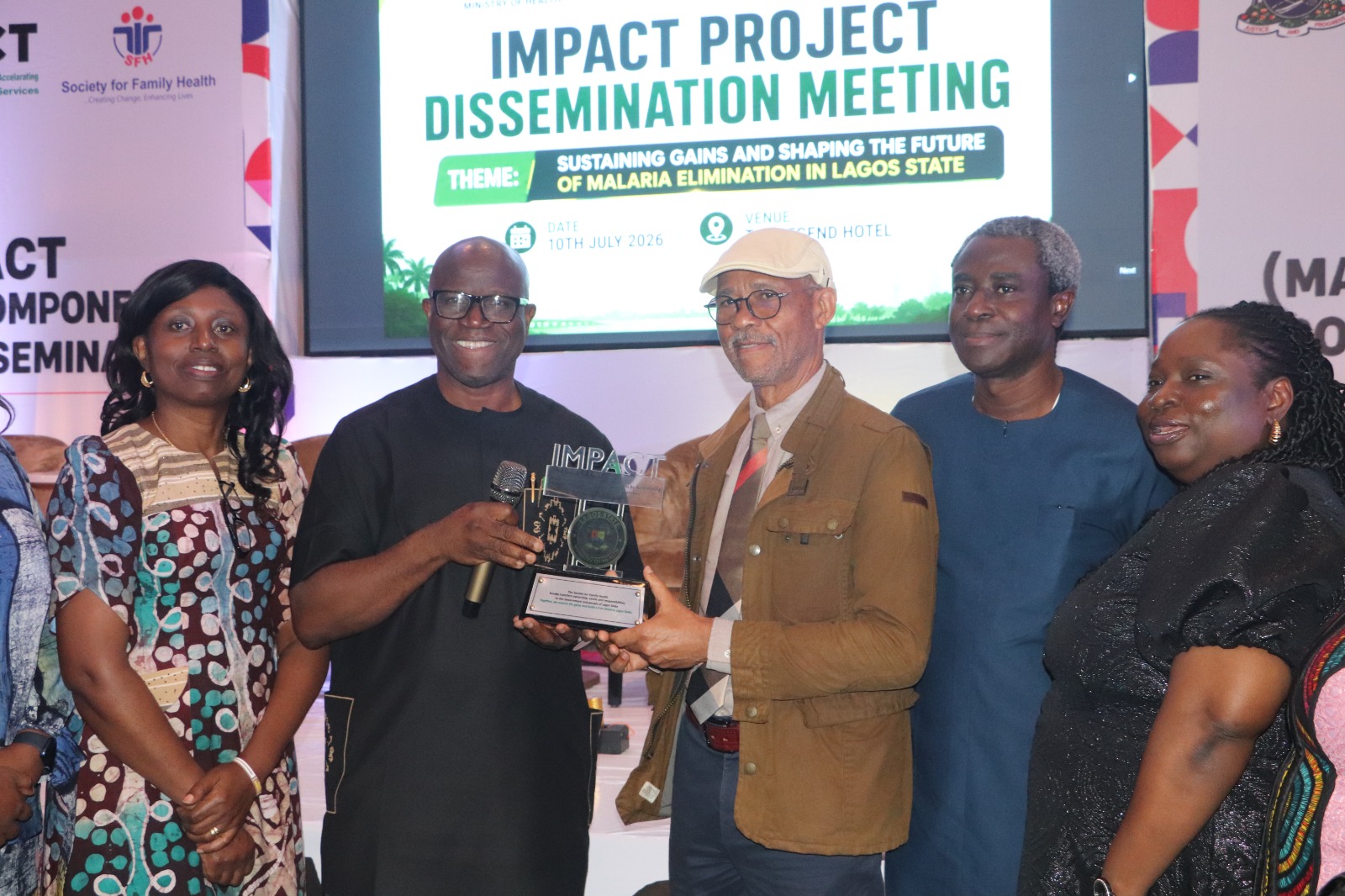
Abayomi spoke at the dissemination meeting of the Immunization Plus and Malaria Progress by Accelerating Coverage and Transforming Services, IMPACT, Project, held in Ikeja.
The World Bank-supported project was implemented by the Society for Family Health, SFH, in partnership with the Lagos State Ministry of Health.
According to the commissioner, findings from the project have transformed the understanding of fever management in Lagos and would shape future clinical practice across the state and beyond.
“For far too long, fever has automatically been equated with malaria. Good clinical practice begins with listening carefully to the patient’s history, conducting a thorough examination and using appropriate diagnostic tools before reaching a conclusion,” he said.
Abayomi disclosed that the state had already directed all public primary and secondary health facilities not to treat malaria unless patients tested positive through Rapid Diagnostic Tests, RDTs.
He said inspections carried out after the directive showed a significant reduction in malaria diagnoses, confirming the effectiveness of the policy.
The commissioner also recalled cases of patients who died after being repeatedly treated for malaria despite testing negative, warning that assumptions in clinical practice could have fatal consequences.
“Today, we are ushering in a new era where fever management will be guided by evidence rather than assumptions, where diagnosis will precede treatment, and where better clinical practice will ultimately save more lives,” he added.
Group Chief Executive Officer of SFH Group, Dr. Omokhudu Idogho, said the project supported malaria diagnosis for more than two million patients across 314 public and 289 private health facilities, while over 50,000 confirmed malaria cases received free treatment.
He added that malaria test positivity declined from 43 per cent to 29.2 per cent during the project’s implementation.
Idogho said one of the project’s biggest achievements was changing clinical practice by encouraging healthcare providers to test before treating patients.
“Not every fever is malaria. Treating every fever as malaria can lead to missed diagnoses, inappropriate use of medicines and poor patient outcomes,” he said.
Permanent Secretary, Lagos State Ministry of Health, Dr. Dayo Lajide, represented by Acting Director of Disease Control, Dr. Abosede Wellington, said malaria prevalence in Lagos had dropped to about 2.6 per cent in 2025, placing the state on the path to malaria pre-elimination.
She said the project strengthened malaria prevention, diagnosis, treatment and immunisation services across the state’s 20 Local Government Areas and 37 Local Council Development Areas.
World Bank Task Team Leader and Senior Health Specialist, Dr. Onoriode Ezire, described the project’s findings on non-malaria fevers as a significant contribution to public health, noting that the evidence generated in Lagos was already influencing health policy.
Presenting the project’s technical findings, malaria researcher, Prof. Wellington Oyibo, said malaria positivity among patients presenting with fever in Lagos was about five per cent, while microscopy recorded only 2.4 per cent positivity.
According to him, quality-assured Rapid Diagnostic Tests demonstrated about 98.5 per cent sensitivity, making them reliable for routine malaria diagnosis and supporting the state’s malaria elimination strategy.
Managing Director of SFH Advisory Services, Dr. Jennifer Anyanti, said the project also procured antimalarial medicines, Rapid Diagnostic Test kits and healthcare waste management commodities while strengthening healthcare workers and community leaders across the state.
She added that the intervention trained Patent and Proprietary Medicine Vendors and community pharmacists to test before treating malaria, improving access to RDT kits at community pharmacies.
Also speaking, State Malaria Elimination Programme Project Manager, Dr. Abimbola Oshinowo, said 1,279 healthcare workers were trained on malaria case management across 343 public health facilities.
She added that malaria testing coverage rose to 98.3 per cent, while uptake of intermittent preventive treatment for pregnant women increased from 25 per cent to 93 per cent.
According to her, community mobilisation reached more than 1.38 million residents, while media campaigns delivered malaria prevention messages to over 10 million people across the state.
Executive Secretary of the Health Facility Monitoring and Accreditation Agency, Dr. Victoria Egunjobi, said the project had equipped healthcare workers with evidence to assure patients that not every fever was caused by malaria.
Stakeholders at the meeting called for sustained investment in healthcare worker training, disease surveillance, uninterrupted supply of diagnostic commodities and stronger community engagement to consolidate the gains made under the project and accelerate Lagos’ journey towards malaria pre-elimination.